KIDS

Montessori Phonics Apps for Beginning Readers
Rosie’s Phonics Ladder is a collection of interactive Montessori-inspired literacy apps that help young children move naturally from hearing sounds to reading complete sentences. Children can listen to letter names and phonetic sounds, trace letter shapes, explore illustrated words, practice blending short vowel CVC words, and hear simple sentences read aloud in Rosie’s own voice. Each activity builds on the one before it, supporting sound-symbol recognition, vocabulary, handwriting readiness, decoding, and early reading confidence through calm, self-paced practice.
A Gentle Learning Path
Three experiences that grow together
The apps can be enjoyed separately, but together they create a natural progression from meeting letters to recognizing them confidently and using them to build words.
Meet
1
See the letter, hear its name and sound, connect it to a familiar word, and practice forming it.
Recognize
2
Listen carefully, scan the alphabet, retrieve what you know, and match the correct letter.
Build
3
Hear simple words, separate and blend their sounds, and trace the letters from left to right.

Meet the letters with Nana
Meet the Letters with Nana bridges timeless Montessori principles with thoughtful digital design, offering early learners a self-directed, tactile alphabet experience right on the screen. Designed to foster independence and intrinsic motivation, the app uses clean color-coding to help children visually distinguish consonants from vowels while offering self-correcting progress tracking through personalized practice piles.
By pairing authentic phonetic audio and engaging visual associations with hands-on digital letter tracing, KayneCreek Kids delivers a distraction-free, child-led environment where young minds can freely explore, self-assess, and master letter-sound relationships at their own natural pace.
Why I created it
Early literacy should feel personal, peaceful, and purposeful. This app gives children time to become truly familiar with each letter instead of rushing them toward memorization.
Find the Letter
Find the Letter — Rosie brings the iconic Montessori Moveable Alphabet to life in a dynamic, digital search-and-find format that invites children into active literacy exploration. Designed around self-correction and spatial awareness, the app presents a clear target letter alongside an ordered A–Z grid—allowing young learners to apply alphabetical order, visual discrimination, and auditory matching at their own pace.
Color-coded consonant and vowel tiles reinforce phonetic structure, while playful feedback and gentle audio prompts encourage trial, error, and independent mastery without high-stakes pressure.

Why I created it
Children need opportunities to retrieve what they know. This focused matching game encourages careful observation and meaningful repetition without timers, competition, or overstimulation.
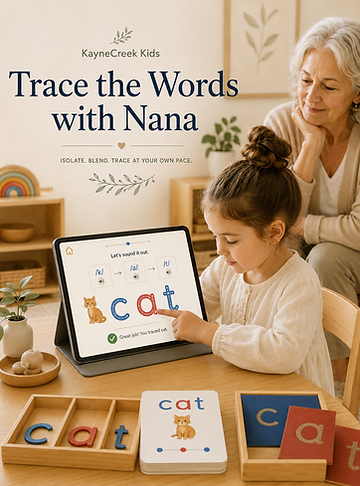
Trace the Words with Nana
Trace the Words with Nana translates the hands-on tactile feedback of traditional Sandpaper Letters and CVC (Consonant-Vowel-Consonant) word building into an intuitive digital workspace. Built around the core Montessori principle of isolating difficulty, the app invites young learners to isolate individual letter sounds, blend them left-to-right, and reinforce muscle memory through smooth, multi-touch digital tracing.
By unifying visual word guides, clear phonetic narration, and self-correcting progress tracking, KayneCreek Kids provides an intentional, child-led environment where early readers build handwriting confidence and phonological awareness at their own natural pace.
Why I created it
Knowing letters is only the beginning. This app helps children discover that letters work together to form words, carry ideas, and make reading possible.
For Parents and Educators
Calm technology with a clear purpose
These apps are not designed to keep a child clicking for as long as possible. Each experience has a defined task, a visible ending, and opportunities to repeat meaningful work.
They draw on Montessori principles, early literacy development, and the understanding that young children learn through the coordinated use of the mind, senses, voice, and hand.
No pressure to perform
Children may repeat an activity, place a letter in the practice pile, erase their work, and try again.
Familiar voices matter
Spoken prompts help make digital practice feel relational, reassuring, and connected to real human learning.
Short, purposeful sessions
A few attentive minutes can be more valuable than a long session. Parents can stop while the child is still engaged and return later.
Use together or independently
Sit beside your child, listen to their answers, and invite them to say the sounds aloud. As their confidence grows, allow them to revisit familiar work independently.